

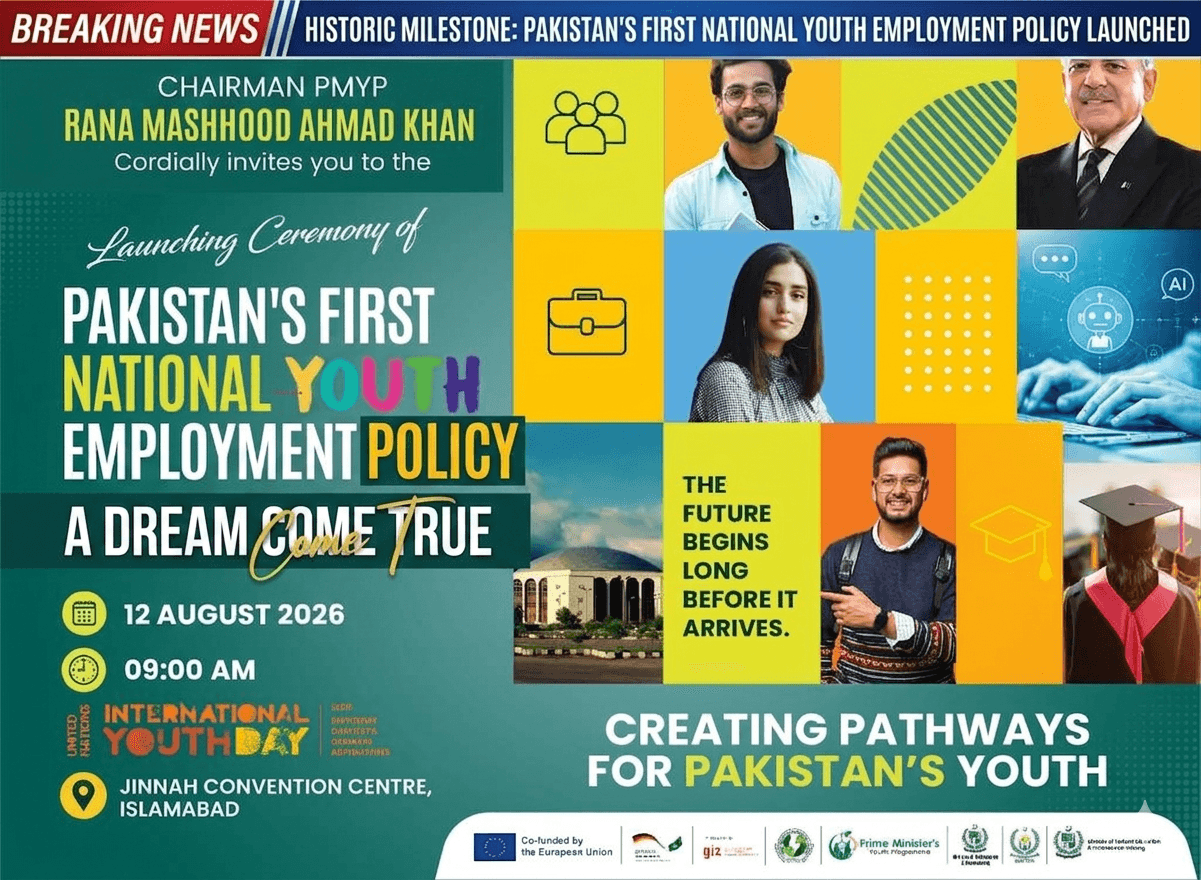
Pakistan’s first National Youth Employment Policy launched on International Youth Day
(Asghar Ali Mubarak)
International Youth Day is celebrated every year on August 12 to recognize the role of youth in the development of society and to draw global attention to their problems.
It may be recalled that Chairman Prime Minister Youth Program Rana Mashhood Ahmed Khan is going to launch Pakistan’s first National Youth Employment Policy on the occasion of International Youth Day to be held in Islamabad on August 12, 2018.
The United Nations has set the official theme of the day for the year 2026 as “Different Contexts, Common Aspirations”.
This theme highlights that although young people around the world live in different economic and social conditions, their aspirations for decent employment, quality education and a sustainable future are exactly the same.
In view of the importance of this day in Pakistan, the government has taken a very historic decision. Prime Minister Shahbaz Sharif is going to formally inaugurate “Vision Pakistan 2047” on the occasion of International Youth Day (August 12, 2026). This vision document is a long-term development roadmap till the completion of 100 years of Pakistan’s independence (2047).
Its entire focus is to make the country’s youth the most important driver of sustainable economic development, modern technology, and national prosperity.
The responsibility of developing this vast national plan has been entrusted to the Chairman of the Prime Minister’s Youth Program (PMYP), Rana Mashhood Ahmed Khan, who is finalizing the future strategy for youth in collaboration with all federal ministries.
Pakistan, in collaboration with the United Nations Youth Task Force, has further activated the “Prime Minister Digital Youth Hub” PID portal on the occasion of this day to provide local youth with employment, skills, and business opportunities at the international level.
Vision Pakistan 2047″ is a long-term and comprehensive national development roadmap of the Government of Pakistan, the main objective of which is to take the country’s economy to 3 trillion (3000 billion) dollars by the completion of 100 years of Pakistan’s independence (the year 2047). This vision document is being prepared directly under the Prime Minister’s Youth Program (PMYP) instead of the traditional planning ministries, for the first time in the country’s history, whose entire focus is to make the 67 percent youth population of the country the engine of economic growth.
The 6 basic goals of this vision, prepared in collaboration with all federal ministries under the supervision of Rana Mashhood Ahmed Khan on the instructions of Prime Minister Shehbaz Sharif, are as follows:
Economic Transformation: To make Pakistan stable and self-reliant and create an export-oriented economy so that dependence on external debt and the IMF can be completely eliminated.
Human Capital Development: Providing high-quality education, excellent health, and world-class vocational training to the country’s young population to meet the challenges of the modern world.
Technological Advancement: Increasing domestic exports by promoting the IT sector, artificial intelligence, and e-commerce under the Digital Pakistan vision.
Environmental Sustainability: Protecting Pakistan from the effects of climate change through green youth movement and alternative energy initiatives.
Governance Reforms: Ending corruption by introducing modern digital systems in all government institutions, bringing transparency and speeding up file work.
Sectoral Priorities: Doubling production by introducing modern technology in key sectors such as agriculture, livestock and mining.
Meanwhile, the Prime Minister launched the Digital Youth Hub (DYH) is a central one-stop digital platform of the Government of Pakistan, developed in collaboration with the United Nations (UN) Youth Task Force and UNICEF to directly provide global and local opportunities to millions of youth in the country.
According to the Press Information Department (PID) and the official portals of PMYP, the UN Resident Coordinator Muhammad Yahya and the UN Task Force (including UNICEF, UNDP, and ILO), under the supervision of Chairman Rana Mashhood Ahmed Khan, have described this portal as a revolutionary data architecture for the youth of Pakistan.
The UN partnership and the 3 core pillars and key features of this portal are as follows:
Direct onboarding of UN agencies: All UN Youth Task Force affiliates (such as UNHCR, UNICEF, etc.) have registered on this portal and can apply for all UN international internships, fellowships, and job opportunities. are advertising directly on this platform so that Pakistani youth can get global exposure.
Youth Supply Registry: On this portal, youth create their verified digital profiles, which store data on their education, skills, and career aspirations so that they can be selected on the basis of merit.
Opportunity Demand Registry: An integrated database for government ministries, non-governmental organizations (NGOs), UN agencies, and the private sector where they list jobs, scholarships, and skills training programs.
AI-Based Analytics Engine
:
This portal uses artificial intelligence to automatically recommend the most suitable jobs or educational scholarships to youth according to their profile and also identifies skills gaps in the country.Legal Protection (FAYDA Act): This portal has been provided with regular legal protection under which all federal ministries of Pakistan are required to list all their youth-related programs and schemes on this single digital youth hub. Free Access and Downloads: Millions of youth are benefiting from this portal so far and its mobile application is also available on the Play Store so that youth can easily apply for jobs, internships, and business loans through their mobile.

“Vision Pakistan 2047” and its sub-project “Uraan Pakistan” have set very revolutionary and big goals for the IT and freelancing sectors to make Pakistan the next big digital hub of the region. The government has expressed its determination that only the transition from a traditional economy to a digital economy can put the country on the path of sustainable development. Under this vision, the main goals set for the IT and freelancing sector are as follows:
Big target for IT exports:
The government has set a target of increasing the country’s IT exports to $60 billion annually in the next few years, for which the tech ecosystem is being strengthened,
Development of the freelancing industry:
Increasing the income of Pakistan’s freelancing industry to $5 billion is a key part of this vision. Under this, the number of active freelancers in the country will be increased to more than 1 million and their average annual income will be increased to $5,000.
Establishment of Quantum Valley and National Centers:
The foundation of Quantum Valley is being laid in the country to meet the needs of the 4th Industrial Revolution.
In addition, special national centers will be established for artificial intelligence (AI), quantum computing, and nanotechnology. Smart capital and tax-free zones for startups: To promote tech startups, government-sponsored seed funds are being established that will work in conjunction with private venture capital.
Along with this, special tax-friendly zones will be created to facilitate business procedures.
Provision of digital infrastructure and 5G: To give equal opportunities to the youth of small towns and rural areas of the country, the fastest internet, cloud access, and digital infrastructure are being expanded so that every talented youth can connect to the global market.
Global Certifications and High-Tech Skills: In collaboration with international institutions like Microsoft, Coursera, Harvard and edX, youth are being provided with free global certifications in future fields like Artificial Intelligence (AI), Cyber Security, Data Science, and E-Commerce.
Remember that the Government of Pakistan has created two major avenues for providing financial assistance to technology startups, IT companies and e-commerce businesses, including government grants without ownership share and bank loans on easy terms. The largest financial scheme is the “Pakistan Startup Fund” (PSF) which works under the Ministry of IT and Ignite and provides co-investment grants to large-scale tech startups. The fund provides up to 30 percent of a startup’s total funding round in the form of a government grant, ranging from a minimum of $50,000 to a maximum of $1 million, without the government taking any ownership or share in the company. To be eligible for the fund, a startup must be registered in Pakistan, be less than 10 years old, be an active tax filer, and have an initial investment agreement with an approved venture capital (VC). New entrepreneurs who have not yet received funding from a venture capital firm can approach Ignite’s National Incubation Centers (NICs) across the country, where the best performing IT ideas are given a seed grant of up to Rs. 2 million free of charge upon completion of business training. For those who want to expand their business through loans, there is the Prime Minister’s Youth Business Loan Scheme, which has reduced the age limit to 18 years for IT and e-commerce founders, provided that they are at least matriculated. The scheme consists of three tiers, in which under the first tier, a completely interest-free loan of up to Rs 5 lakh is given without any collateral or security. In the second tier, a loan of Rs 5 lakh to Rs 1.5 lakh is available at a mere 5% markup and a personal guarantee, while in the third tier, a larger loan of Rs 1.5 lakh to Rs 7.5 lakh can be obtained at a mere 7% markup by providing security as per the bank’s credit policy. All these loans are given a long and easy repayment period of 7 to 8 years, including a one-year grace period, so that the technology business can be made profitable before the installment payments start. To apply online for this scheme, the applicant must have an identity card, educational degree or IT certificate, active NTN, complete business plan, and if the company is registered, registration documents from the Securities and Exchange Commission of Pakistan (SECP)Furthermore, “Vision Pakistan 2047” is a long-term and comprehensive national development roadmap of the Government of Pakistan, with the main objective of taking the country’s economy to 3 trillion (3000 billion) dollars by the completion of 100 years of Pakistan’s independence (the year 2047). This vision document is being prepared directly under the Prime Minister’s Youth Program (PMYP) instead of the traditional planning ministries, for the first time in the country’s history, whose entire focus is to make the country’s 67 percent youth population the engine of economic growth.


