



Defense Agreement, Pakistan Nuclear Power 1.710 million troops, large military pillar ....(Asghar Ali Mubarak) ….
Under the Makkah Joint Defense Agreement, Pakistan has emerged as the largest military pillar of this new defense alliance with its more than 1.7 million active and reserve military force, nuclear deterrent and extraordinary combat capabilities.
According to international defense think tanks (such as SIPRI) and military experts, in this tripartite alliance, where Saudi Arabia provides strong economic resources and Turkey brings its advanced defense industry and NATO-standard technology, Pakistan is providing the largest conventional military force and strategic nuclear umbrella to the entire bloc. The number of active military personnel in the Pakistan Army, Air Force and Navy is approximately 650,000, while the combined strength of more than 500,000 reserve forces and other auxiliary military and paramilitary forces exceeds 1.7 million. This number is the largest active military force among the three countries in the alliance. Pakistan is at the forefront with 1.71 million troops. Pakistan has extensive and practical combat experience in conventional wars, long-term counter-terrorism campaigns, and recent regional conflicts, which is considered a very important asset for the security of the Gulf. Pakistan is the only nuclear power in the alliance, which is estimated to have more than 170 nuclear warheads and the most advanced long-range ballistic and cruise missile systems (such as the Shaheen and Ghori series). In an environment of intense military campaigns in the Middle East and regional instability, Pakistan’s nuclear and missile capabilities have been included in the alliance under NATO’s collective defense principle (attack one, attack all), which will serve as a strong deterrent against any external power. After the continuation of the September 2025 Mutual Defense Agreement (SMDA) and the tensions caused by the Iran war in February 2026, Pakistan has already deployed thousands of its troops, JF-17 fighter jets, and advanced drone squadrons. And the military defense system has been deployed for the security of Saudi Arabia.
After the geopolitical changes in the Middle East and the US-Israeli war on Iran, the security structure of the region has changed completely. In this situation, Saudi Arabia, Turkey and Pakistan have taken a historic step and signed the Mecca Joint Defense Agreement, which has been named the ‘Mecca Joint Defense Agreement’. Talking about the manpower of the three major Muslim powers involved in the historic alliance, this military bloc has a total of more than 3.118 million soldiers, including active army, reserve force and paramilitary personnel. Pakistan is at the forefront of this manpower with 1.710 million personnel, while Turkey has 1.011 million and Saudi Arabia has 3.97 million military personnel.
This alliance also appears to be in a very strong position on the air and naval fronts. The air forces of the three countries have a total of 3,415 combat aircraft, of which Pakistan has 1,397, Turkey has 1,101 and Saudi Arabia has 917 aircraft.
In terms of naval power, the alliance has a total of 344 ships, including 38 frigates (Turkey has 17, Saudi Arabia has 12 and Pakistan has 9).
For underwater defense, the alliance has a total of 22 submarines, of which Turkey has 14 and Pakistan has 8 submarines, while Saudi Arabia currently has no submarines.
These three countries have unparalleled capabilities in the field of land defense weapons and artillery. They have a large fleet of 6,046 tanks in total, of which Pakistan has 2,677, Turkey has 2,284 and Saudi Arabia has 1,085 tanks.
In the artillery sector, the alliance has a huge stockpile of 2,087 self-propelled artillery, 3,821 towed artillery and 1,216 multiple rocket launchers (MLRS).
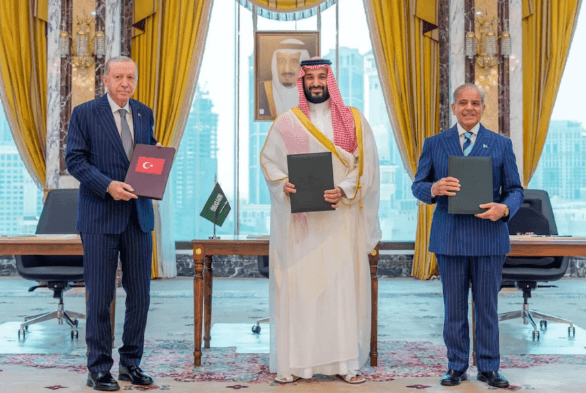
The financial and strategic foundations of the military alliance are also very solid. The combined annual defense budget of these three countries reaches 124.5 billion US dollars, with Saudi Arabia allocating the largest budget with 64 billion dollars, while Turkey’s defense budget is 51.4 billion dollars and Pakistan’s budget is 10 billion dollars. This alliance has a huge strategic advantage in the form of Pakistan because Pakistan is the only nuclear power among these three countries with more than 190 nuclear warheads. All these figures have been officially revealed, however, the actual capabilities may be much higher. At the time of signing this historic agreement at Qasr al-Safa in Mecca, Prime Minister Shehbaz Sharif was specially present along with Pakistani Army Chief Field Marshal Asim Munir, whose personal and tireless military diplomacy has been recognized as the main motivation for the establishment of this trilateral alliance. According to international political analysts, Pakistan’s emergence as the “big military brother” in this strategic alliance proves that the Gulf countries are now reducing their dependence on the Western security umbrella and establishing a new and independent defense bloc within the region with major Muslim military powers like Pakistan and Turkey.Experts are calling the agreement not just a piece of paper but a new balance of power in the region. “Regional countries have been skeptical about the sustainability of US security partnerships for more than a decade,” says Kristin Coates-Srichsen, a fellow at Rice University’s Baker Institute. “The US military operations against Iran and the subsequent war tactics have exacerbated these concerns, which is why these countries are diversifying their security relationships. However, the new defense agreements are not intended to make them a substitute for the US, but to gain additional strategic and policy options.” Similarly, Sina Toosi, an analyst at the Center for International Policy, said that “this is the first major geopolitical sign that the US and Israel’s war on Iran is reshaping the regional system.” “Instead of relying entirely on Washington, Saudi Arabia is now broadening the scope of its security partners, which is the most important point in this whole matter.” Yasmin Farooq, an analyst at the International Crisis Group, stressed that the agreement should not be seen as a direct confrontation with Iran, as the three countries have always talked about reducing tensions and mediating. “What these countries have in common is that they do not want to escalate regional tensions,” she said. “The importance of this agreement is actually to establish a moral or principled deterrent that can promote long-term strategic cooperation.” Michael Kugelman, senior fellow for South Asia at the Atlantic Council, said of Pakistan that “this agreement gives Pakistan a more important role in the emerging security architecture of the Middle East.” “This agreement will give a Muslim-majority, nuclear-capable state like Pakistan more prestige and influence in the region, which will create a positive image of Pakistan on the global stage.” Regarding Turkey, Ozgur Onluhasarkikli, director of the German Marshall Fund, said that “the three countries have complementary strengths. According to observers, Israel sees the agreement as an “oppositional Sunni bloc” against its growing military influence in the region, in which NATO’s second largest army (Turkey), the world’s largest economic power (Saudi Arabia) and a country with nuclear capabilities (Pakistan) have come together. The Indian Ministry of External Affairs said in a brief statement that New Delhi is “closely following” the agreement and its provisions. On the other hand, there has been no official comment from Israel and the United States on this so far, but in the past, Israeli officials have seen such an alliance as a bloc against them. Although in practice there are still questions as to whether other countries will directly jump in if one country’s war breaks out again, for now the agreement is a very good way to prevent any potential aggression in the region. It will prove to be a major strategic weapon, which will greatly increase the cost of the attack for the enemy. In a ceremony held at Qasr al-Safa in Mecca, Prime Minister Shahbaz Sharif, Saudi Crown Prince Mohammed bin Salman, and Turkish President Tayyip Erdogan signed the agreement on behalf of Pakistan. The joint statement said that this agreement is based on historical relations, Islamic solidarity, common strategic interests and long-standing defense cooperation between the three countries. The aim of the agreement is to strengthen the joint defense capability against aggression, expand defense cooperation and play a role in promoting peace, security and stability in the region and the world.
According to the Foreign Office of Pakistan, after this agreement, an attack on any one of Pakistan, Saudi Arabia or Turkey will be considered an attack on all three countries. The Foreign Office, while announcing the joint defense agreement in a statement, said that the aim of this agreement is to further strengthen defense cooperation, mutual contacts and a common security system between the three countries. Saudi Deputy Minister for Public Diplomacy Dr. Raed Karimli said that Pakistan, Turkey and The defense agreement between Saudi Arabia and Turkey is not intended to target any country or group or replace existing defense agreements. According to them, the agreement reflects the strong and strategic relations between the three countries spanning several decades and was concluded after years of detailed negotiations. Turkish officials have also made a similar statement regarding the agreement, saying that under this trilateral agreement, the three countries will only be obliged to assist each other in defense matters. Turkish officials have clarified that this agreement is not made against any specific country, state or party, but is open to other countries in the region to join it. This defense agreement does not terminate or replace any existing bilateral or multilateral agreements between Turkey, Pakistan and Saudi Arabia or with other states and international organizations of these countries.


