

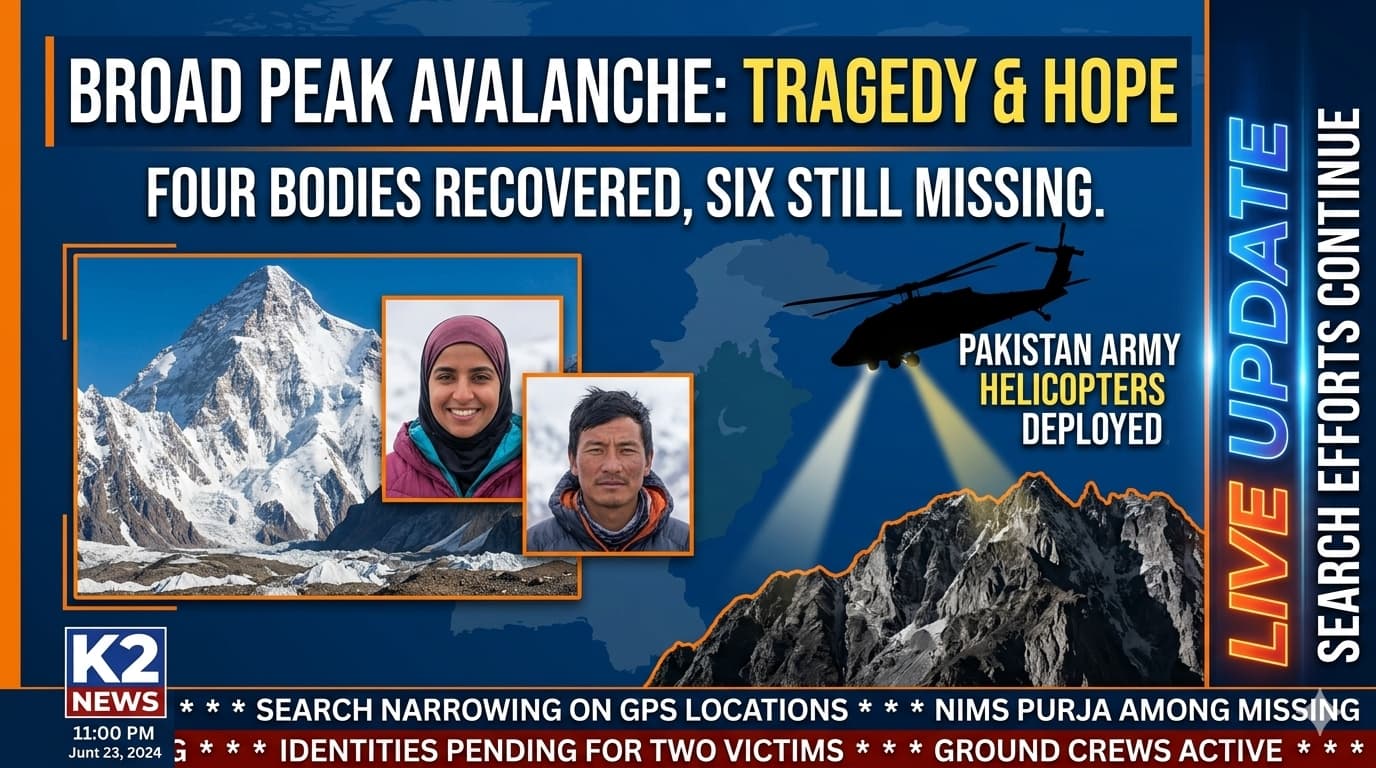
4 bodies recovered after 10 climbers go missing on Pakistani mountain, Broad Peak

(Report; Asghar Ali Mubarak)
Pakistani search crews have recovered four bodies from the bottom of the slide area opposite Broad Peak Base Camp following Thursday’s massive avalanche. Ground rescue teams from Karakorum Expeditions located the victims, who were carried down hundreds of meters by the force of the snow.According to reports verified by the Alpine Club of Pakistan (ACP), the current status of the recovery operation includes the following details:Recovered VictimsInitial Confirmations: Outfitter reports indicate that two of the four recovered bodies have been identified as Nadhira Al Harthy of Oman and Pur Bahadur Gurung (Yukta) of Nepal.Official Verification Pending: The Alpine Club of Pakistan is working with base camp officials to formally confirm the identities of the remaining two recovered climbers.Ongoing Search for the Remaining SixAerial Deployment: Two Pakistan Army Aviation rescue helicopters carrying specialized high-altitude equipment have been dispatched to Scour the mountain.Missing Team Status: Famed mountaineer Nirmal “Nims” Purja and Pakistani climber Sohail Sakhi remain among the six individuals still unaccounted for.GPS Signals: The search is narrowing down on a remote area where the tracking devices of four climbers are still emitting location pings.
Four bodies have been recovered following a catastrophic avalanche on the Karakoram’s Broad Peak. Ground rescue teams from Karakorum Expeditions discovered the victims at the base of the slide zone, opposite the Broad Peak Base Camp. The victims were carried down several hundred meters by the sheer momentum of the snow.
The disaster struck on July 30, 2026, when an international 10-climber expedition was hit around midday local time. This coverage provides the verified details confirmed by the Alpine Club of Pakistan (ACP) alongside the critical regional background.
Current Recovery Status & Victims
Rescue personnel have managed to access the impact zone despite highly volatile high-altitude terrain:
- Identified Victims: Preliminary field reports from outfitters indicate that two of the four recovered bodies belong to Nadhira Al Harthy of Oman and Pur Bahadur Gurung (Yukta) of Nepal.
- Awaiting Identification: The Alpine Club of Pakistan is working closely with base camp administrators to officially identify the other two recovered climbers.
- The Missing Six: Six individuals remain unaccounted for, including the world-renowned team lead Nirmal “Nims” Purja (Nimsdai) and prominent local Pakistani climber Sohail Sakhi.
+————————–+————-+————————————+
| Climber Name | Nationality | Current Status |
+————————–+————-+————————————+
| Nadhira Al Harthy | Oman | Deceased (Body Recovered) |
| Pur Bahadur Gurung | Nepal | Deceased (Body Recovered) |
| Nirmal “Nims” Purja | Nepal | Missing |
| Sohail Sakhi | Pakistan | Missing |
| Mallory Geis | USA | Missing / Electronic Signal Active |
| Wang Zhong | China | Missing / Electronic Signal Active |
+————————–+————-+————————————+
The Active Rescue Operation
The search and rescue effort has scaled up into an intense, multi-agency operation:
- Aerial Assistance: The Pakistan Army Aviation has deployed two specialized search and rescue helicopters equipped with high-altitude tracking gear to scan the higher upper slopes.
- Electronic Tracking: Search crews are moving toward a distinct, localized zone where the GPS tracking transponders of four missing team members continue to broadcast location pings.
Relevant Regional & Geographical Background
1. The Treacherous “Breit Peak”
Broad Peak—historically designated as K3—stands at 8,051 meters (26,414 feet) above sea level, making it the 12th highest mountain on Earth. Located in the Karakoram range of Gilgit-Baltistan along the Pakistan-China border, its massive summit ridge stretches over 2 kilometers long. It is considered highly deceptive because its lower slopes seem straightforward, but its upper sections feature sheer ice walls and unpredictable cornices prone to breaking.
2. The Mid-Summer Avalanche Window
July marks the peak climbing window in the Karakoram due to warmer temperatures. However, this season also increases the threat of wet-snow avalanches. Rising seasonal temperatures weaken the upper glacial structures, causing heavy ice shelves to fracture. When a block breaks from these upper ridges, it triggers massive snow slides that sweep down the bottleneck channels directly toward Camp 3 and the lower base camps.
3. High-Altitude Air Rescue Limits
Deploying Pakistan Army Aviation helicopters at these heights is incredibly dangerous. At altitudes exceeding 6,000 to 7,000 meters, the air becomes too thin for standard helicopter rotors to generate sufficient lift. Pilots are forced to operate at the absolute mechanical limits of their aircraft, making rescue missions highly dependent on clear visibility and low wind speeds.


