

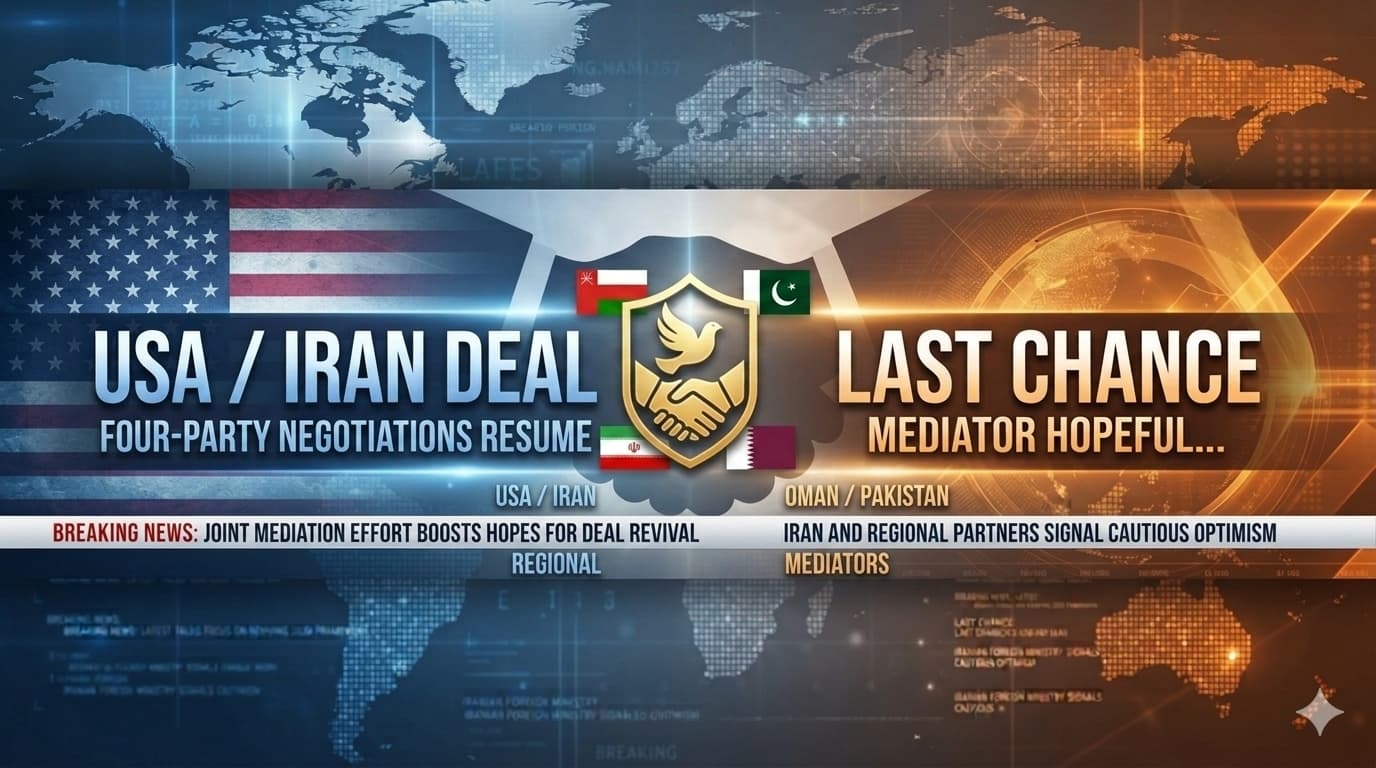
USA, Iran deal, last chance, mediator hopeful…
..(Asghar Ali Mubarak)..
On June 17, 2026, US President Donald Trump and the Iranian leadership digitally signed the “Islamabad Memorandum of Understanding” (MoU) under the mediation of Pakistan. This 14-point draft included a temporary ceasefire, conditional permission to sell oil to Iran, and access to Iran’s frozen development funds ($300 billion). A few days after the signing, big differences arose between the two sides over the control of the Strait of Hormuz and the final terms, which led to the collapse of this temporary agreement. Due to news of positive progress in the negotiations, the prices of crude oil (Brent crude) in the global market have fallen by 5% to below $80 per barrel. US President Donald Trump has made it clear in recent statements that these negotiations are a “last chance” for Iran. He has taken a tough stance, saying that the US naval blockade will not be lifted until a permanent agreement is reached or Iran surrenders. The implementation of agreements between the US and Iran, such as the Islamabad Memorandum of Understanding signed in June 2026, is currently at a critical juncture. US officials claim that an agreement to reopen the Strait of Hormuz to shipping could be reached in the next 24 to 48 hours, while Iran insists that Washington end its blockade and uphold previous promises.
There has been progress in the ongoing efforts of mediators to reduce tensions between the US and Iran. According to Iranian Foreign Ministry spokesman Esmail Baqai, Pakistan continues to play the role of the most important mediator between Tehran and Washington, while Qatar and Oman are also assisting.
Pakistani Prime Minister Shahbaz Sharif and Foreign Minister Ishaq Dar have been in constant contact with the Iranian leadership, aiming to salvage a stalled 60-day diplomatic roadmap.
US President Donald Trump has confirmed that he has called off proposed military strikes on Iran for now to give diplomacy one last chance.
President Trump has claimed to have revived indirect talks and expressed hope that the Strait of Hormuz will be permanently opened to commercial traffic.
Washington insists that the next phase of the deal will require Iran to accept tougher conditions on its nuclear program and uranium enrichment.
The mediators believe that neither side wants to be part of a protracted war, so there is room for compromise despite the temporary tensions.
Qatar, Oman and Pakistan, the mediating countries, are helping to facilitate contacts between Washington and Tehran, exchange drafts of proposed agreements and pave the way for talks.
According to political observers, despite the current stalemate, Pakistan and Qatar’s sincere mediation and the continuous transmission of diplomatic messages between the two economic and military rivals are proving to be the most important weapons in saving the region from a major war.
In this regard, mediator Qatar has expressed hope that the US and Iran can reach an agreement in the next few hours. According to Qatar’s Al Jazeera broadcaster, Qatari Foreign Ministry spokesman Majid Al Ansari said in a briefing on Tuesday that the ongoing mediation efforts to end the tension between the US and Iran have entered a very important stage. There are no direct talks between the US and Iran, but the mediators are in constant contact with each other.
The Iranian Foreign Ministry has currently denied direct talks with the US, but has made it clear that Tehran is fully committed to finding a political and diplomatic solution in the region through mediation.
Iran is currently continuing technical-level talks with Oman on temporary safe shipping lanes and taxes in the Strait of Hormuz.
Speaking about the situation in the Strait of Hormuz, the Qatari spokesman said that Qatar’s position is that this important sea passage should be reopened and shipping should continue as it has been in the past. Iran’s position is that fees or taxes should be collected from ships passing through the Strait of Hormuz, but the US has deemed this proposal unacceptable. According to Qatar, matters related to the Strait of Hormuz should be decided jointly by regional countries so that stability in the region and global energy supplies can remain uninterrupted. He said that Doha supports mediation efforts,
It is hoped that the US and Iran will reach an agreement in the next few days or hours.
Earlier, US Treasury Secretary Scott Besant had also claimed that an agreement with Iran on the Strait of Hormuz issue is likely in a day or two. Negotiations between the US and Iran are ongoing, and both sides are trying to finalize the agreement to reopen the Strait of Hormuz. According to him, if the negotiations are successful, a formal announcement of the agreement could be made within the next 24 to 48 hours. The 14 basic points of the “Islamabad MoU” mentioned above are the original text of the document signed between the US and Iran on June 17, 2026. However, in recent weeks (July and August 2026), the situation on the ground and the status of the agreement have changed dramatically. The 14-point MoU stated that Iran would never acquire nuclear weapons and also promised a $300 billion fund for the country’s “reconstruction and economic development”. The agreement stated that the US, Iran and their allies would declare an “immediate and permanent” cessation of military operations “on all fronts”, including Lebanon. The US and Iran would respect each other’s “sovereignty and territorial integrity” and refrain from interfering in each other’s internal affairs. The United States and Iran will be committed to negotiating and completing a final agreement within a “maximum” period of 60 days, although this period can be extended by mutual consent. The 60-day period has begun as the leaders of the two countries have formally signed the memorandum of understanding. Once the memorandum of understanding is signed, the US will begin lifting its naval blockade and remove “any obstructions or restrictions” on Iranian ports. Part of the agreement states that after signing the memorandum of understanding, Iran will “make best efforts to ensure the safe passage of commercial vessels through the Strait of Hormuz, without any fees.” According to the document, in the longer term, Iran will work with Oman and other Gulf states to form a “broader” agreement to manage the Strait of Hormuz. According to the memorandum of understanding, the US and regional partners will develop a “final, mutually agreed plan” of at least $300 billion (£224 billion) for reconstruction and economic development in Iran. The US will lift all economic sanctions against Iran, including those imposed under UN Security Council resolutions. The sanctions include those imposed unilaterally by the United States.
Iran agreed not to acquire or purchase nuclear weapons, and both sides agreed to resolve the issue of Tehran’s already enriched uranium stockpile. The “status quo” regarding Iran’s nuclear program will remain in place until the issue of enriched uranium is addressed. Iran has long been pushing for the release of its frozen assets to provide the country with another economic boost. The final points of the document said that the United States and Iran would establish a “mechanism” to monitor the implementation of the memorandum of understanding and compliance with a future agreement. Once signed and implemented, the United States and Iran would begin negotiations for a final agreement. Finally, the memorandum of understanding clarified that the final agreement would be ratified by a binding resolution of the United Nations Security Council. In short, the 14 points agreed upon in June have been effectively suspended due to the July fighting, and final efforts are currently underway through Pakistan, Oman, and Qatar to adapt these points into a new temporary framework. Meanwhile, Crude oil prices have fallen sharply in the global market on hopes of a possible agreement between the US and Iran to reopen the Strait of Hormuz. Crude oil has fallen below $80 per barrel for the first time since July 13 after the US Treasury Secretary’s statement. Crude oil prices fell significantly in the global market on Tuesday when the US Treasury Secretary said that an agreement between the US and Iran to open the Strait of Hormuz is likely to be reached “today or tomorrow”. Following this statement, the price of global benchmark Brent crude oil fell by more than 5 percent and fell to $79.50 per barrel, which fell below $80 for the first time since July 13. Similarly, the price of US crude oil (WTI) also fell by more than 5.5 percent and fell to $75.77 per barrel, which is the lowest level in the last 3 weeks. WTI later recovered slightly and was trading at $76.90 per barrel, down about 4.3 percent. According to analysts, investors took Scott Besant’s statement as a positive signal and made buying and selling decisions, but the future of the tension between the US and Iran and the outcome of the negotiations still remain uncertain. On the other hand, the Qatari Foreign Ministry has also said that the ongoing efforts to resolve the dispute have entered a “very positive phase.” On July 23 last month, Brent crude oil reached $100.69 per barrel, but later prices began to gradually decline due to expectations of a decrease in tensions in the region. Over the past few months, several attempts at negotiations between the US and Iran have failed, due to which the global oil market has been subject to severe volatility. The increase in tensions has made crude oil more expensive, which will also have an impact on petrol and diesel prices around the world.
It should be noted that the Strait of Hormuz is one of the world’s most important energy corridors, through which about 20 percent of the world’s daily supply of crude oil and liquefied natural gas passed before the war that began in late February.


